
Science in motion: How different motion creatives drive impact in DOOH
We know what separates a great out-of-home creative from a good one, and including motion is inherently one of the most powerful creative levers available, right? But does motion actually impact campaign performance? We delve into the facts.
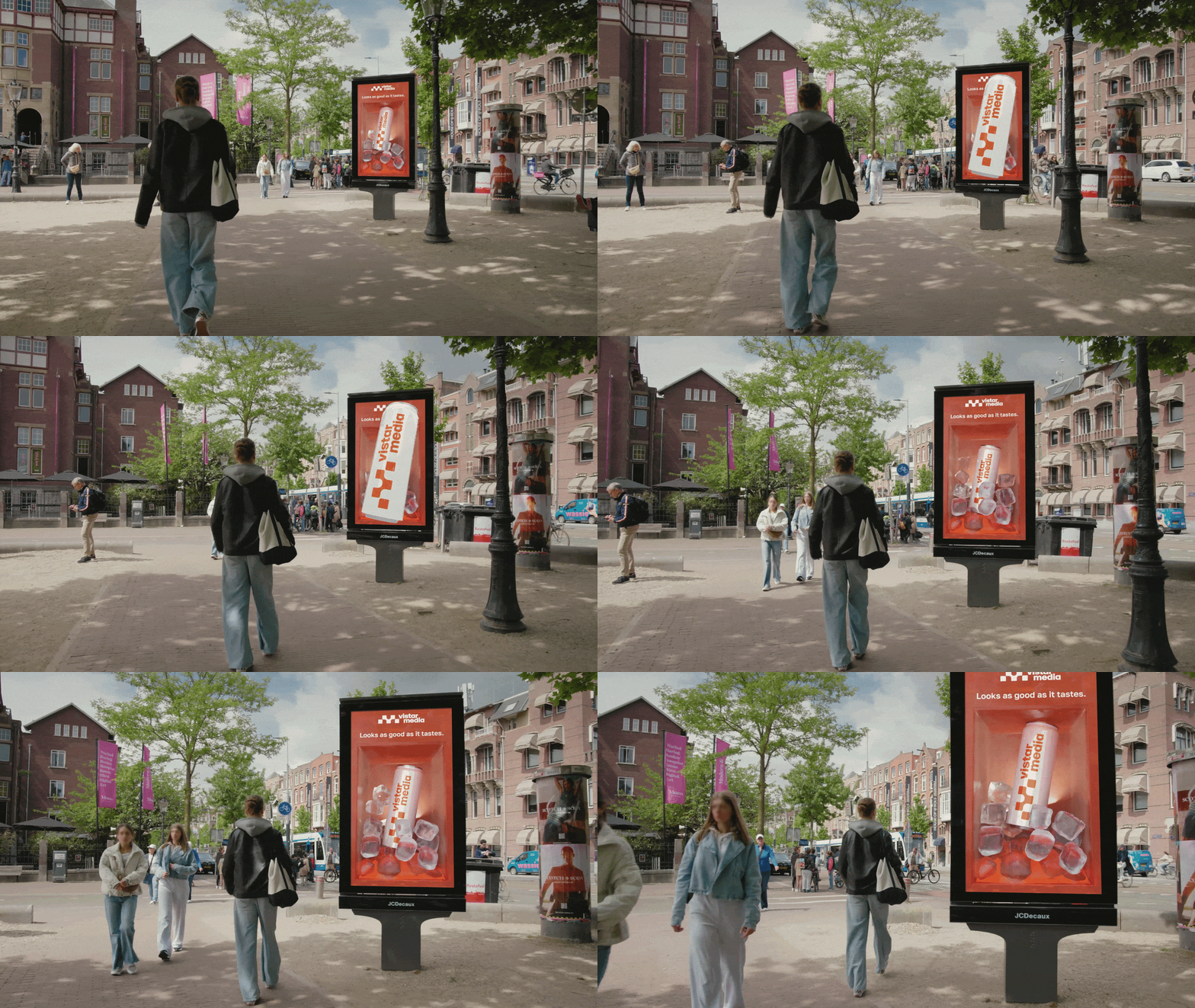
In the world of digital out-of-home (DOOH), the "digital" element is often under-utilised. While the industry has mastered programmatic delivery and audience targeting, the creative format itself remains a critical lever for campaign success. To quantify this, Vistar Media, in partnership with Omnicom Media and JCDecaux, conducted an extensive study involving 7,513 respondents to measure the real-world impact of motion in DOOH creatives.
By testing 3D, full-motion, limited-motion, and static creatives for a number of real-world brands, and comparing them against a control group, the research revealed a clear truth: if you want to make maximum impact with consumers, incorporating motion assets into your repertoire can give you the edge.
*Illustrative example
The study
The ‘Science in Motion’ study was commissioned to understand the effectiveness of digital out-of-home creative, involving over 7,500 respondents across multiple age groups in the Netherlands.
Participants watched footage of a person walking through an outdoor environment where a DOOH ad was visible. But, crucially, they were not asked to focus on the ad, meaning they weren't cognitively primed to respond to that specific element of the video.
After viewing, they completed a survey. Different groups were intentionally exposed to four distinct creative formats—static, subtle motion, full motion, or 3D—across a range of brands from various industries. This deliberate scale ensured the findings would be broadly applicable and not specific to a single category.
"Among marketers, and perhaps even as consumers, it's long been inherently agreed upon that including motion in advertising makes it more engaging. In DOOH, that agreement is perhaps stronger than any other channel, but there is surprisingly little data to actually back up the assumption. That's why the Science in Motion research is so exciting; it doesn't just prove it correct, it shows the impact is potentially even greater than we thought."
Annelijne Brouwer | Data & Insights Manager at Vistar Media
The power of the screen over the format
The most immediate hurdle for any advertiser that is planning an outdoor campaign is that the DOOH ecosystem allows for different creative specifications and formats, of which one the most discussed differentiations are static or motion.
While digital screens technically can show motion creatives, local governments restrict motion to ensure road safety. For example, regulations usually allow only static creatives on billboards next to highways to prevent ads from grabbing attention away from the road. This often leads advertisers to worry that a static ad might be a 'compromised' version of their campaign, lacking the punch of a full-motion creative. However, our research shows that these concerns are largely unfounded.
*Illustrative example
The data reveals a narrow gap in ad recall between different formats. When looking at aided ad recall, static creatives showed a massive +38% uplift compared to the control group. In comparison, full-motion creatives achieved a +41% uplift. This difference indicates that the DOOH medium itself, the high-quality digital screen and its location, does the heavy lifting. Marketers can rest assured that static ads are not 'lesser' ads; they are highly effective tools for building reach and recognition.
*Illustrative example
3D: The Strategic Differentiator
Where we do see a significant shift, is in how deeply the brand is anchored in the consumer's mind. While all formats drive recognition, 3D creatives are the absolute winners in building Top-of-Mind Awareness (TOMA). With a +10% uplift in TOMA brand awareness compared to the control group, 3D is 67% more effective than when there was no form of motion applied. By creating a sense of depth and physical presence, 3D doesn't just catch the eye; it embeds the brand into the viewer’s memory far more effectively than a flat, static image.
Having a selection of both static and 3D motion creatives is our top recommendation for DOOH best practice.
"This research provides clear evidence of how different creative formats—from static to 3D—drive impact in DOOH. More importantly, it gives strategists a practical framework to make data-driven decisions, enabling them to select the right format based on campaign objectives, audience, and context—ensuring each DOOH campaign delivers optimal impact."
Marit van Zon | Insight & Effectiveness Consultant at Omnicom Media
Full motion vs. subtle motion
Perhaps unsurprisingly, full motion creative is next in line as most effective in driving TOMA brand awareness (+8% against the control group). Yet, it is the heavy lifter for simple recall with an uplift in spontaneous recall of +18% and + 41% in aided recall compared to the control group.
Limited motions have shown similar results. This suggests that the intensity of the animation is less important than the presence of motion itself. For advertisers, this is a key takeaway: you don't necessarily need complex, high-budget video productions to achieve high impact. A subtle animation, such as a spinning product or animating your logo, can be just as effective in anchoring the brand and message in the viewer's mind as a fast-paced, full-screen video.
Generational shifts
The impact of motion is felt across all demographics, but the way different age groups respond to specific formats varies. The 18–34 demographic generally shows the highest overall uplift scores, responding with high energy to all dynamic formats, particularly full-motion.
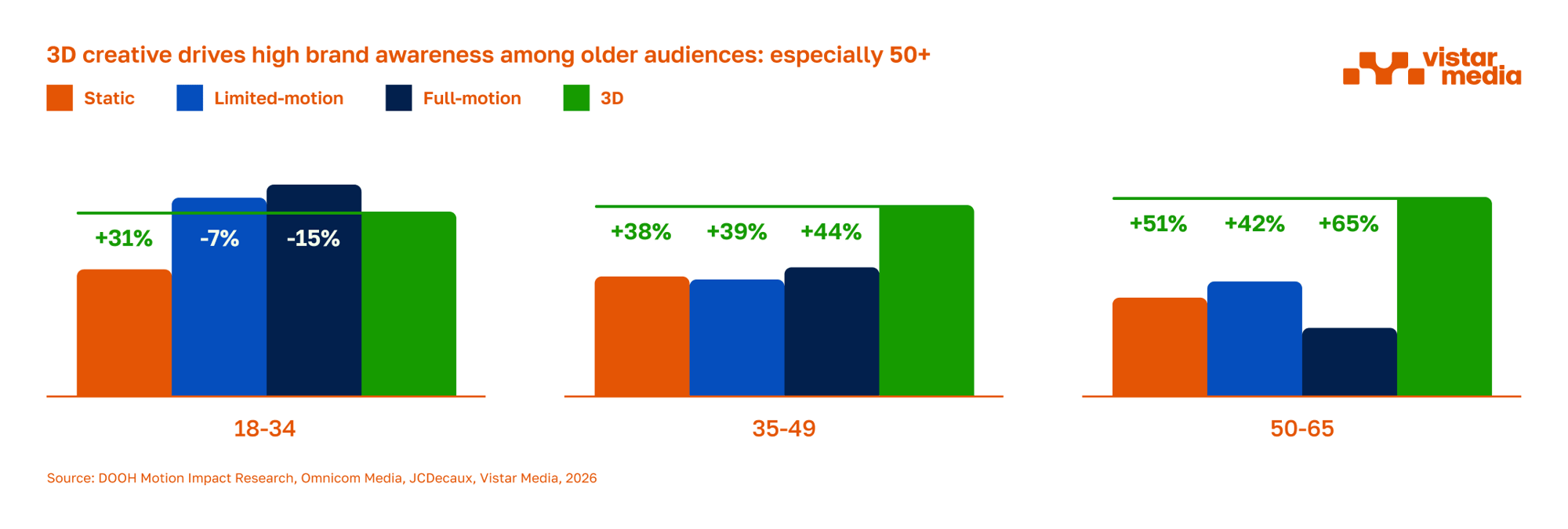
Interestingly, 3D creative proves to be an incredible tool for reaching older demographics. For both the 35–49 and 50–65 age groups, 3D had the strongest recorded effects. Specifically for the 50–65 group, 3D was identified as "by far the most effective format" for brand awareness (both TOMA and spontaneous). This suggests that the immersive nature of 3D carries a unique resonance for older consumers, making it a versatile tool for broad-reach campaigns.
Multi-dimensional performance
The findings of this study reflect the performance we see in our creative and campaign delivery work for some of the world's biggest advertisers.
For instance, a 3D motion execution developed by our team for La Roche-Posay ran alongside static assets produced by the brand itself. Measured against every metric including brand awareness, ad recall, message comprehension and appeal, the 3D creative delivered incredible performance across the board.
The reason behind it? Clarity. Respondents said that the 3D unit made it noticeably clearer what the product actually was, and that it looked more appealing. That combination of functional clarity and emotional pull is one of the most interesting things 3D enables: it makes product-led creative feel emotionally resonant rather than purely transactional.
The right format for your objectives
In summary, while the data reveals a narrow gap in ad recall between different formats compared against to control group, adding motion creates an average 33% uplift in ad recall and +50% in brand awareness compared to static.
Interestingly, while Full Motion is the top performer for recall among 18-34 year-olds, 3D becomes an absolute powerhouse for older audiences, delivering nearly double the impact of other formats for the 50-65 demographic.
The takeaway for planners and creative agencies is clear: to maximise the effectiveness of your out-of-home investment, your creative format must align with your primary KPI:
| Creative format | Strategic role | Key data insight |
| Static | Recall baseline | Delivers a massive +38% aided ad recall, proving that location and screen quality drive impact even without motion. |
| Subtle motion | Efficient awareness | Proves that minimal movement is enough to drive peak brand awareness (+8% TOMA), often outperforming full video. |
| Full motion | Attention grabbing | The ultimate format for high-speed recognition, achieving the highest spontaneous recall (+18%), and second best in TOMA brand awareness (+8%). |
| 3D motion | Brand powerhouse | The absolute winner: delivers a massive +44% in aided ad recall, and +10% in TOMA brand awareness. It is 67% more effective in driving brand awareness than when motion is not applied. |
"This research is, ultimately, a starting point, not an endpoint. The real creative opportunity lies in first understanding which format is appropriate for your audience and campaign, and then executing your creative vision with genuine precision. "
Martine Hammink | VP, Creative Studio at Vistar Media
Vistar Media is the home of out-of-home. Our creative studio are at the forefront of OOH creative innovation, already working with the world’s biggest brands to ensure they achieve maximum impact from their advertising investment.
Whether you’re working with us already or are yet to embark on your OOH journey, by embracing the findings of our Science in motion report, brands can finally bridge the gap between simple visibility and genuine consumer influence.

Subscribe to Our Blog
Get the Latest Insights