
The store locator effect: how store information moves audiences from screen to store
The right message at the right moment matters. So, does adding a store locator have any impact on your campaign? And if so, does where it’s placed on the creative matter? We explored the effect behind the store locator in programmatic DOOH.
.jpg)
One of the biggest advantages of programmatic digital out-of-home is its ability to adapt creative in real time. Through Dynamic Creative Optimisation (DCO), brands can serve more relevant messages based on where audiences are and what is happening around them. Among the most widely adopted applications is the store locator, automatically pointing consumers to their nearest retailer, restaurant or dealership.
But while location-aware creative has become an important part of pDOOH, two questions have remained largely unanswered: Does adding a store locator actually have any impact? And if so, does where it’s placed on the ad matter?
To answer these questions, Vistar Media’s Creative Studio partnered with Omnicom Media and Annalect to look into how store locator placement influences consumer intent, uncovering how creative execution can drive both visit or purchase intent (depending on the industry category).
“Store locators might seem like a small part of a DOOH creative, but this research shows that small creative decisions can have a meaningful impact. It’s not simply about adding location information; where it sits, how clearly it stands out and how it works with the rest of the creative all matter. What this research gives us is evidence to make those creative decisions more intentionally, while recognising that there is no one-size-fits-all approach.”
Martine Hammink, VP of Creative Studio, Vistar Media
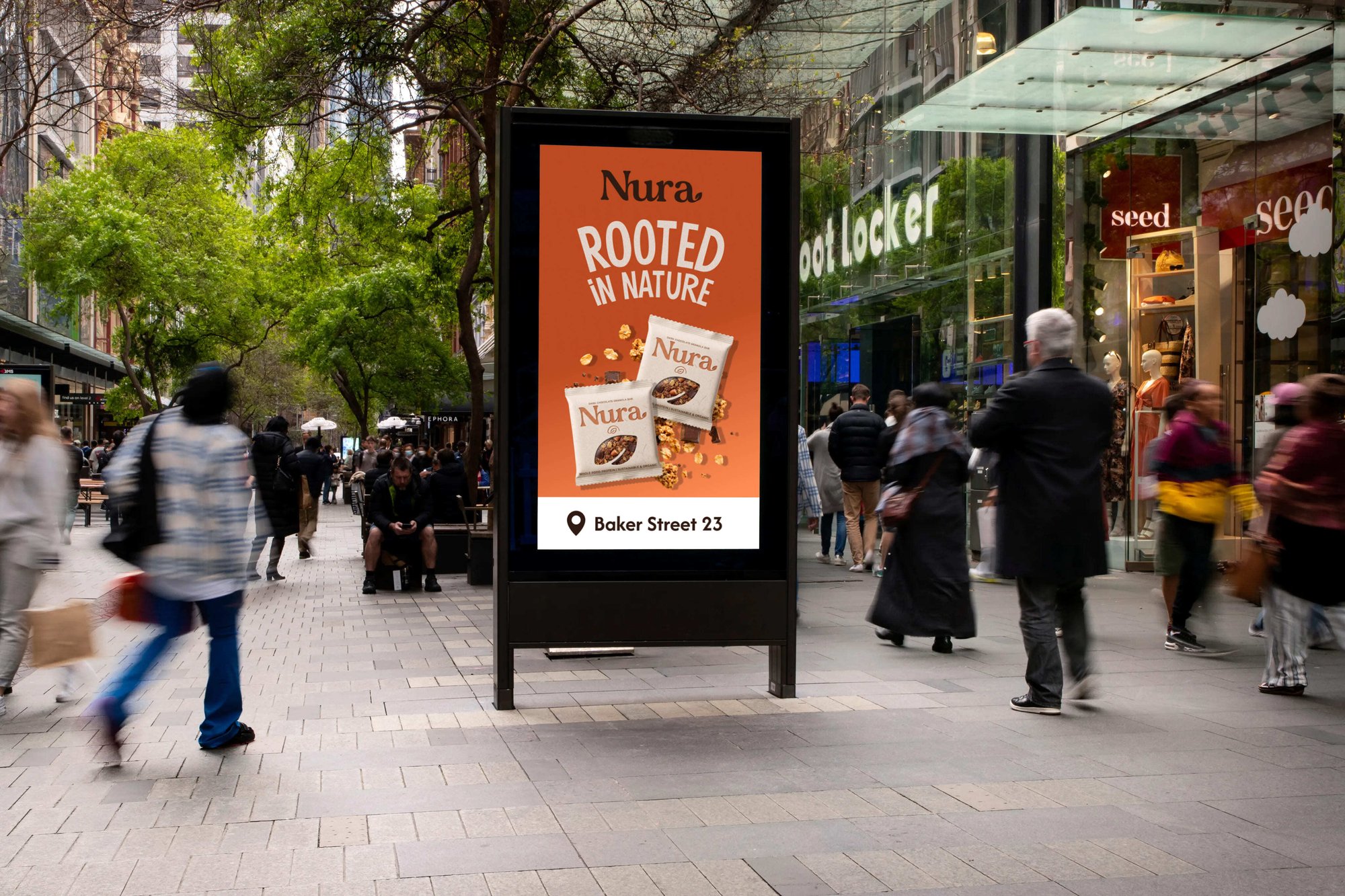
*Illustrative example
The study
To put these questions to the test, the research was conducted among 7,200 consumers aged 18–59 using a forced-exposure research design.
Participants were randomly shown an image of an outdoor environment featuring a vertical outdoor 1080 x 1920 screen displaying the campaign creative. Depending on the test group, they saw either a control version without a store locator or one of three variations where the store locator appeared at the top, middle or bottom of the ad.
To ensure the findings extended beyond a single industry, campaigns across three categories were included:
-
Retail, covering businesses that sell products or services directly to consumers through physical locations, such as grocery, home improvement and apparel retailers;
-
Quick Service Restaurants (QSR), such as fast food and coffee chains;
-
Consumer Packaged Goods (CPG), such as food, beverage and other everyday consumer products.
Together, these categories represent a range of purchase behaviours, from everyday convenience purchases to more considered buying decisions.
To reflect the different ways consumers interact with each category, the study measured visit intent for Retail and QSR campaigns, and purchase intent for CPG campaigns. Alongside intent, the study also looked at brand recognition, brand appreciation and ad appreciation, giving us a broader picture of how store locators can shape both consumer response and brand perception.
"Store locators are widely used in DOOH, but there’s been little data on the difference they actually make. What makes this research exciting is seeing how strongly intent can shift based on placement and category.
Annelijne Brouwer, Data Strategy Manager, Vistar Media
Creative executions
The study evaluated three common ways advertisers integrate store information into pDOOH creatives.
-
Top placement: store information appears close to the brand’s logo, where audiences naturally direct their attention first.
-
Middle placement: store information is integrated into the campaign's main message, blending with other copy and visual elements.
-
Bottom placement: store information appears below the primary creative.
Each placement was benchmarked against the control creative, allowing the research to isolate the impact of placement alone.
.jpg?width=2000&height=1150&name=VM_Store%20Locator-Creative%20overview3x%20(1).jpg "VM_Store Locator-Creative overview")
Placement of store locator changes the outcome
The results showed that adding store information can influence consumer intent, but where it appears on the creative makes a difference. Across the study, top and bottom placements delivered the strongest results, while the middle placement was less consistent.
The overall measurements included:
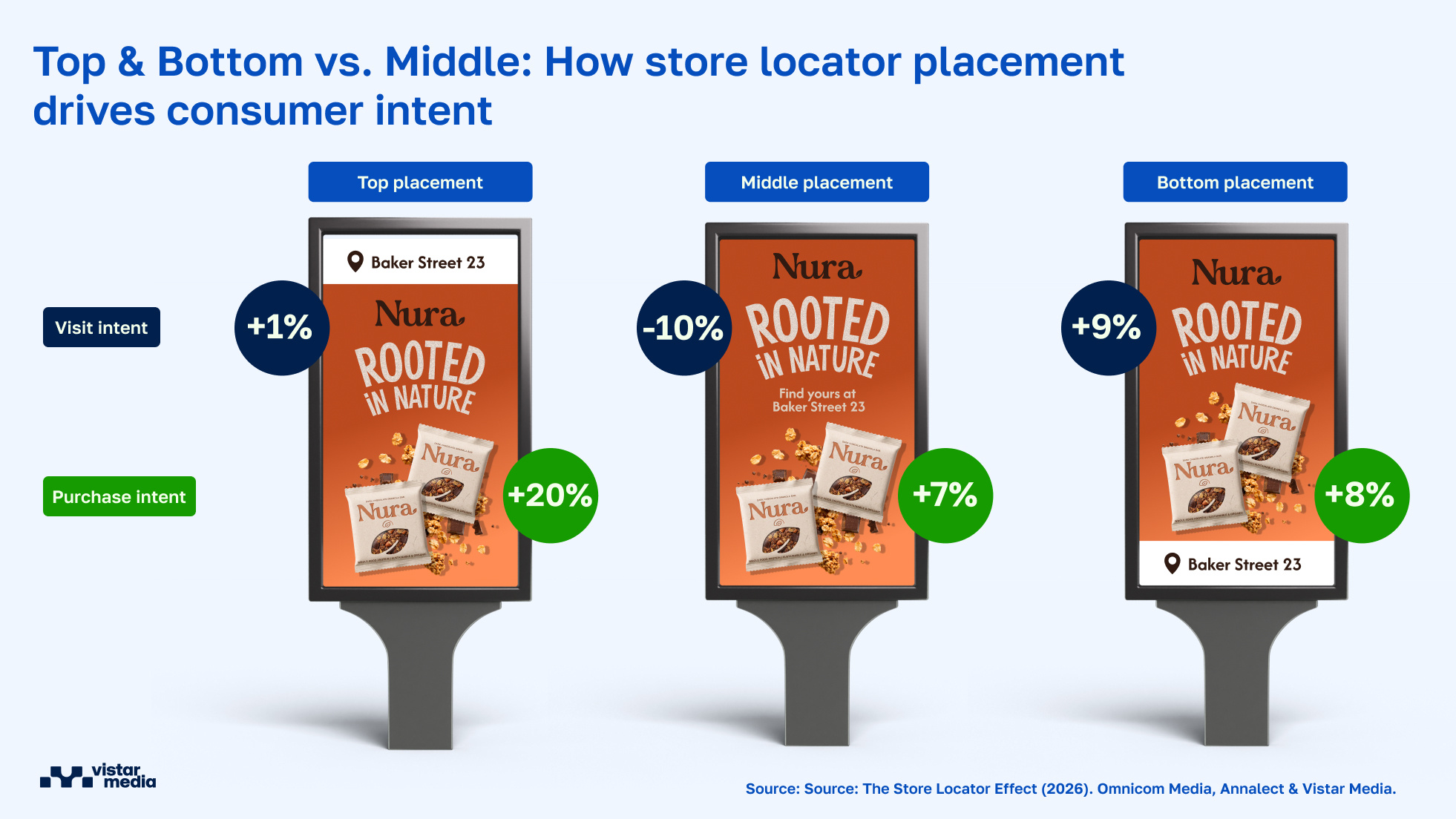
Why was the middle placement less consistent? Because when store information sat in the middle of the creative, it competed with headlines, imagery and other visual elements, making it easier to overlook. Top and bottom placements gave the information its own visual space, helping consumers recognise it almost instantly.
Some product categories saw even stronger effects
While the overall trend was positive, certain categories responded particularly well to store content.
- For Retail stores - bottom placement increased visit intent by 35% compared to the control group.
- For QSR - bottom placement lifted visit intent by 24%.
- The strongest results came from Consumer Packaged Goods, particularly impulse-buy products such as candy (e.g sweets and chocolate), where purchase intent increased by 116% for bottom placement and 110% for top placement.
These findings suggest store locators become increasingly valuable when consumers are able to make an immediate purchase decision.
Execution matters as much as placement
Placement wasn't the only factor driving intent.
Across the highest-performing creatives, two executional elements appeared again and again:
-
High contrast between the store information and the rest of the creative.
-
A familiar location pin that immediately communicates where the product or service can be found.
These seemingly small design choices delivered measurable results:
-
+16% uplift in visit intent when a location pin was used.
-
+10% uplift in both visit and purchase intent (depending on the industry category) when high-contrast design was applied.
The takeaway is clear: how store information is designed is just as important as where it appears
.jpg?width=500&height=705&name=VM_Storelocator_Design%20tricks2x%20(2).jpg "VM_Storelocator_Design tricks")
“The work we did for Vistar on the store locator effect showcases what great data, tech & insights can achieve. Together we were able to find meaningful insights, showcase the strength of the proposition with relevant nuance, and drive better outcomes for advertisers, publishers, and agencies”
Chris van Kampen, Strategic Insights & Product Lead Media Science, Annalect
Key takeaways
The research highlights five clear takeaways for advertisers looking to make dynamic creative work harder:
1. Adding a store locator can increase consumer intent. Across the research, adding store information positively influenced visit intent for Retail and QSR campaigns, and purchase intent for CPG campaigns, without negatively impacting brand or ad appreciation.
2. Placement matters. Top and bottom placements consistently outperform the middle, where store information is more easily overlooked.
3. Creative execution is just as important as placement. High contrast and familiar location pin icons make store information easier to recognise and act on.
4. The impact varies by category. Store locators are particularly effective for Retail, QSR and impulse-buy CPG products.
5. Additional branding can influence brand recognition. Featuring a reseller or dealership can support consumer action, but may also divide attention and, in some cases, reduce recognition of the advertised brand.
.jpg?width=2000&height=1130&name=VM_Anatomy%20of%20DOOH%20Store%20Locator2x%20(1).jpg "VM_Anatomy of DOOH Store Locator2x (1)")
Important considerations
The research also uncovered an important nuance: creative context matters.
When a store locator prominently featured another brand, such as a supermarket, dealership or retailer, brand recognition for the advertised product sometimes declined, even when the relevant visit or purchase intent metric remained strong. The additional branding appeared to divide attention between the advertiser and the reseller. For campaigns focused on building brand recognition, particularly for newer or emerging brands, this is worth considering when designing store locator content.
It’s also important to consider the scale of the research. The findings reflect the specific screen format, creative executions and advertising environments tested in the study. Screen size, format and the overall execution of the creative can all influence how prominently store information appears and, ultimately, how audiences respond. The results should therefore be viewed as evidence of the impact these creative choices can have, rather than a universal rule for every DOOH format or screen.
What the research does reinforce is that execution matters. Wherever store information appears, its placement, prominence and relationship with the rest of the creative should be considered within the context of the screen and format being used.
Dynamic creative, designed to drive action
As brands continue investing in Dynamic Creative Optimisation, the opportunity extends beyond serving the right message at the right moment.
This research shows that how dynamic content is integrated into a creative can be just as important as what content is displayed. When thoughtfully designed, a simple store locator becomes more than a piece of dynamic information - it becomes a measurable driver of consumer action.
“With Programmatic DOOH and DCO, we can deliver outdoor ads far more efficiently at the right place, time, and moment. That means better visibility, attention, and engagement. This study gives us the solid backing and real insights we need. Seeing how dynamic solutions like store locators perform lets us shift from "using potential" to "proving real value"."
Roos Goesz, OOH Director, Omnicom NL
Subscribe to Our Blog
Get the Latest Insights